
Lee Huynh, 2025 Texas Pathfinder Cohort
Among all National Math Stars, it’s safe to assume that Lee Huynh has the fastest punch.
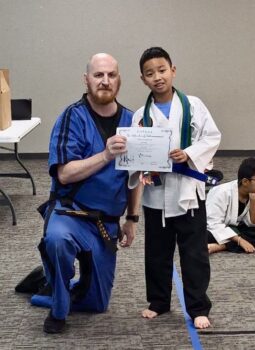 A 10-year-old fourth grader from Fort Worth, Texas, Lee has been in karate training for two years and holds a blue belt. He recently won two gold medals at a karate tournament, both in reaction-time events: fastest punch and fastest kick.
“They use a special pad,” Lee explains. “They show you a screen, and when it turns green, you punch or kick, and they measure your time.”
But it’s hard to say which is faster: Lee’s fists or his mind.
When it comes to academic prowess, Lee has been punching above his weight since he was very young. His mom, Kim, noticed it early. At about 24 months old, he was counting into double digits and showed an impressive memory for everything put in front of him. By kindergarten, Lee was doing standard arithmetic with large numbers.
Acknowledging his natural abilities, his school was able to accelerate his math studies somewhat – but not as much as he needed. They placed him in hybrid math, letting him move a year ahead of his classmates, but could not allow him to go further without having him skip entire grades. “It was too easy for me,” Lee says, remembering that math coursework, “but if I go to fifth grade for math, then I have to learn fifth-grade reading too. I wasn’t quite at that level yet.”
The perfect solution came by way of Lee’s third-grade teacher, who suggested he apply to National Math Stars. Lee worked through three rounds of qualifying assessments and earned his place in the program.
Now Lee works at his own pace. “They give me AoPS classes,” he says excitedly. “There’s also a program called Beast Academy that I do. It lets me go on my level, but at the same time it doesn’t push me too far.” He joins the program’s regular virtual chess and puzzle clubs, and in his first year as a Star, he placed in the top 20 nationally in the Math Kangaroo competition.
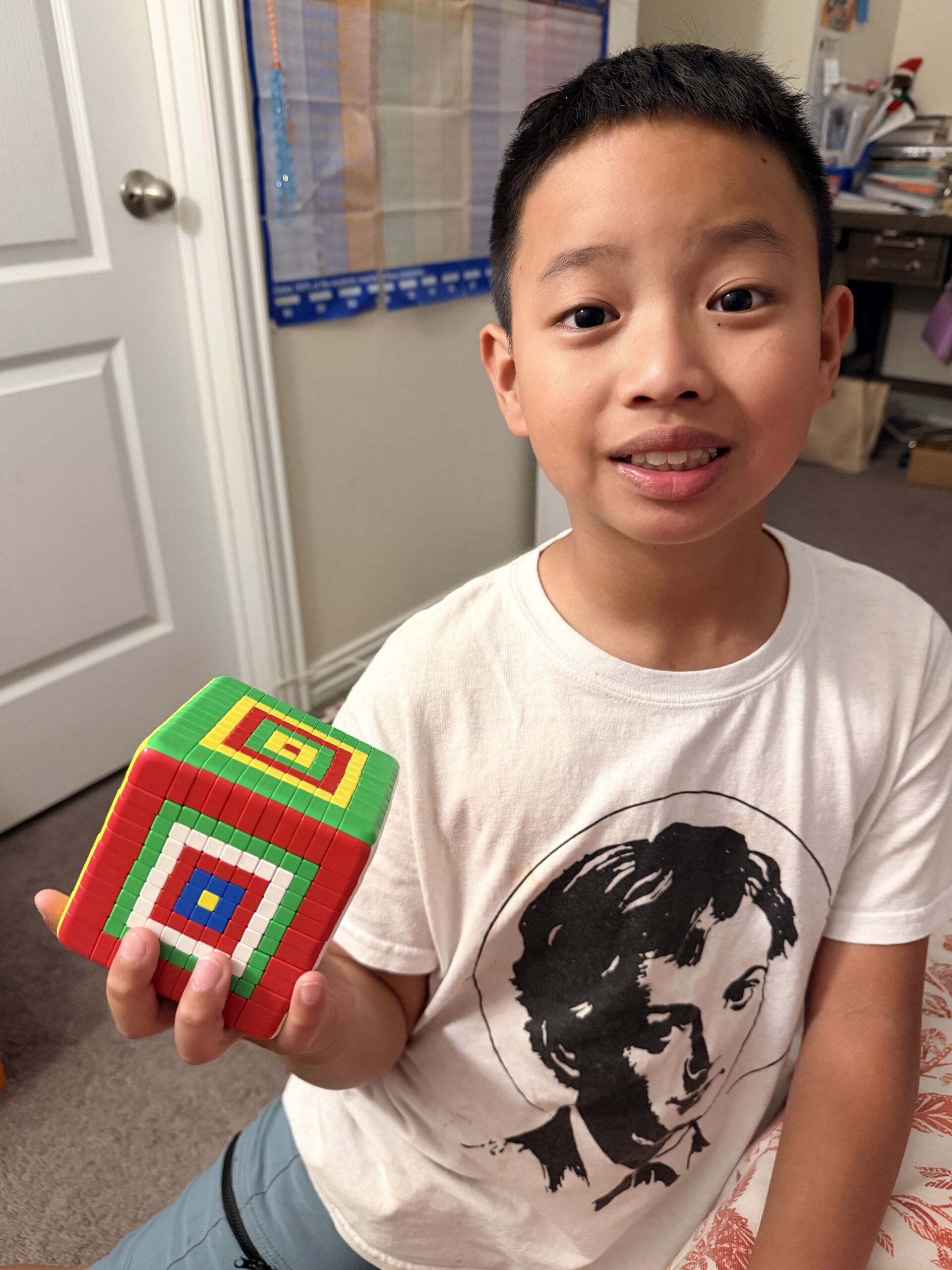
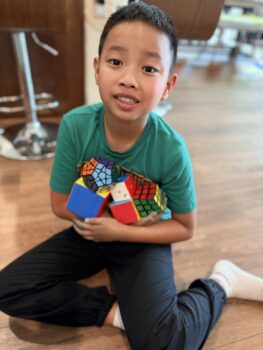 Much like his punches and kicks, Lee’s Rubik’s Cube chops have also become lightning quick – a skill that started with his National Math Stars welcome package. “When he qualified, they were so kind and sent a bag including a Rubik’s Cube,” Kim recalls. “Later they sent an email with a tutorial. He learned it in about two days.”
Lee’s collection has grown steadily since. His latest is an 11x11x11 cube. “I solved it before, but I scrambled it again, and now I’m nearly done [again],” he says. He has his eye on even bigger cubes. “A 21×21 is the biggest they make. But then for some reason, some guy 3D printed a 49×49.”
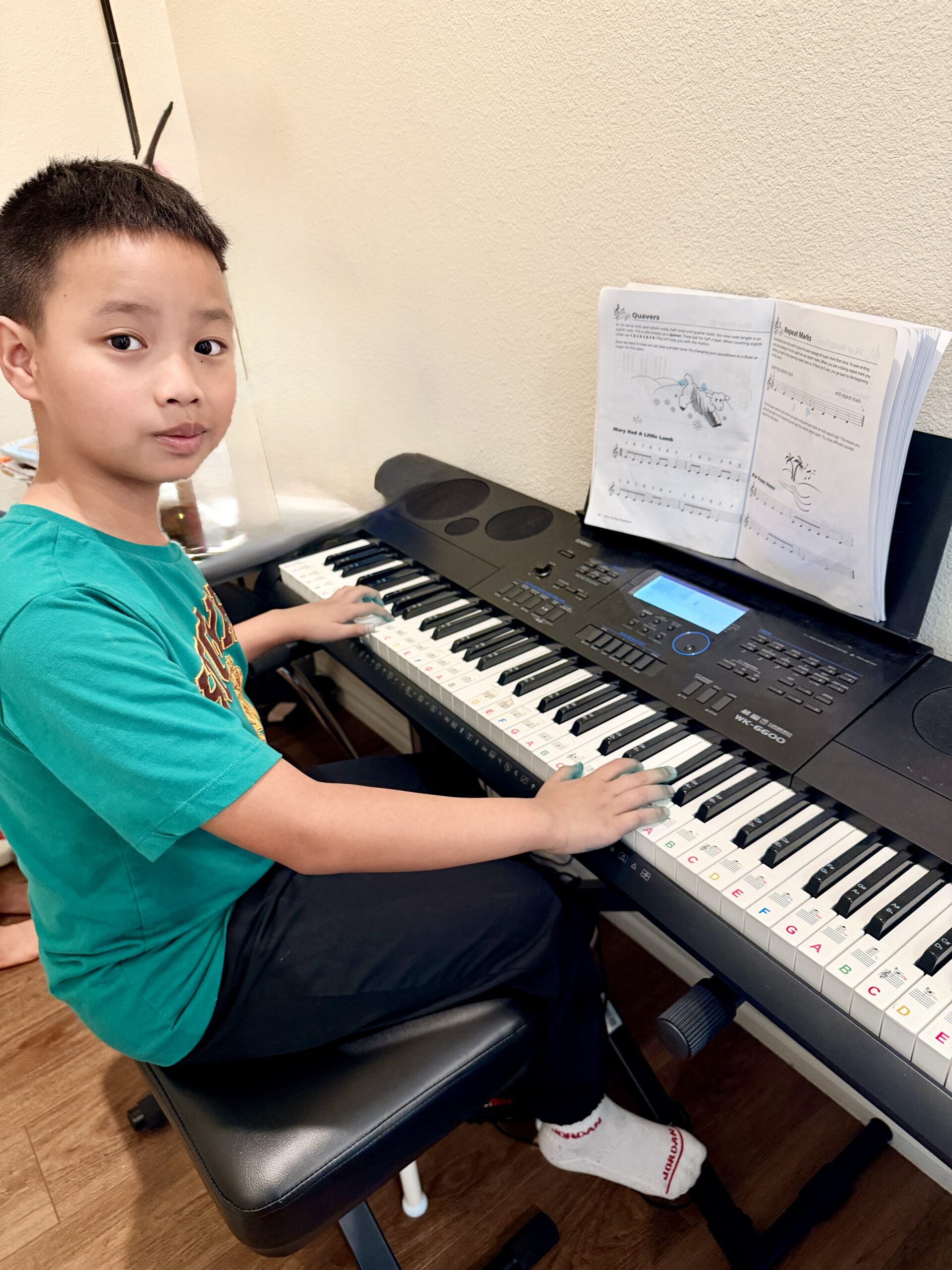
Lee’s tendency to teach himself extends beyond puzzles. “Lee doesn’t have professional training, but he can play piano,” Kim says. “At first, I just showed him some basic notes. Later, he used a book and watched videos to learn by himself. If he wants to learn a song, he just listens and tries to do it himself.” Lee has also read all seven Harry Potter books (“the battles are my favorite parts”), and this summer he plans to explore 3D printing.
Ask Lee what he likes best about National Math Stars, and his answer is simple: “the math activities and the events” – especially the chance to connect with other kids like him.
“National Math Stars gives him what his school cannot. He learns at his own level now,” Kim says. “Whatever he wants to learn, he just watches, listens, and teaches himself. As his mom, I am so proud. I can’t wait to see how far he goes.”